
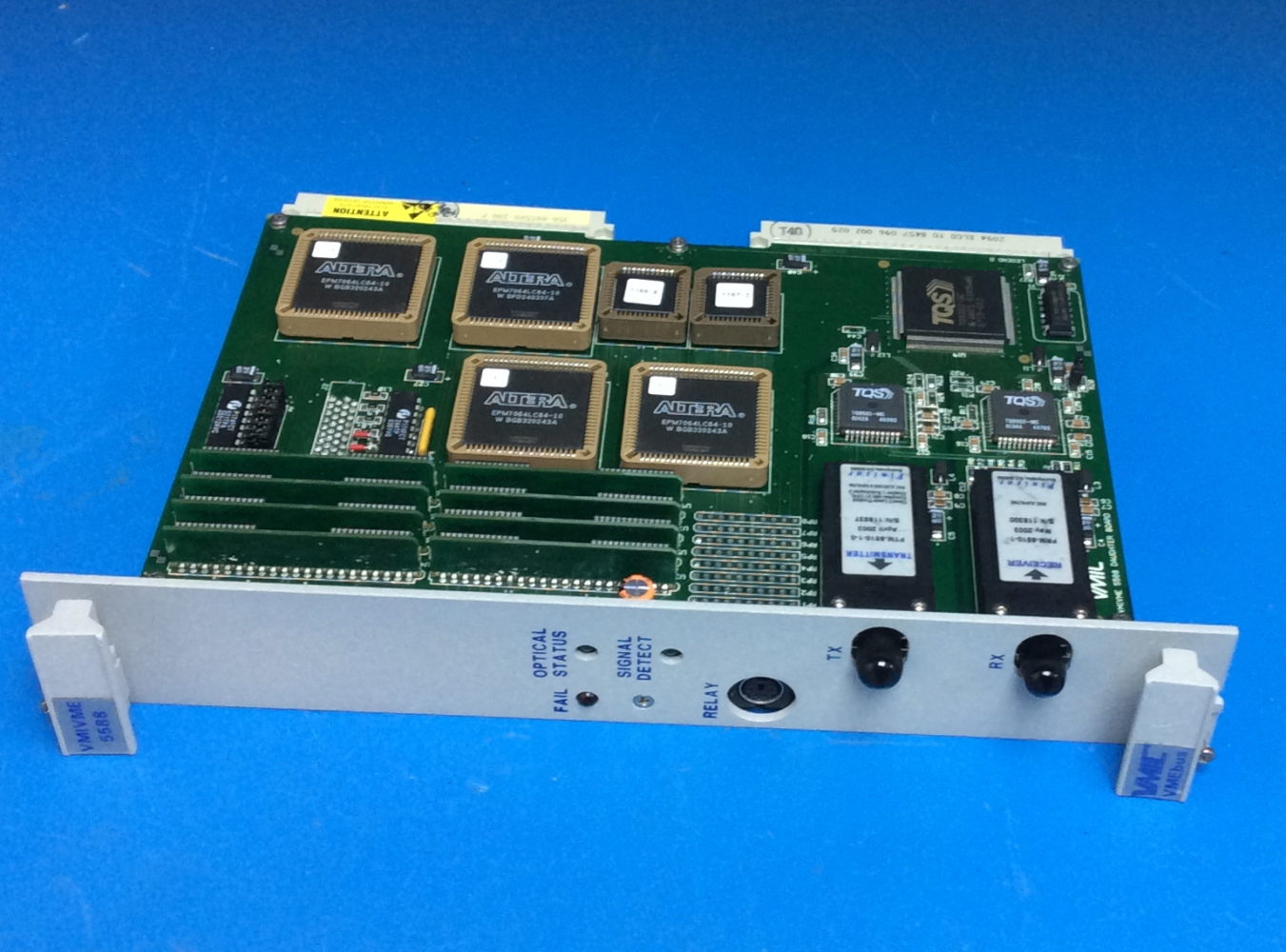

VMIVME5588-210
INTRODUCTION — VMIVME-5588 is a
high-performance, daisy-chained VME-to-VME network.
Data is transferred by writing to on-board global RAM. The
data is automatically sent to the location in memory on all
Reflective Memory boards on the network.
PRODUCT OVERVIEW
— The Reflective Memory
concept provides a very fast and efficient way of sharing data
across distributed computer systems.
VMIC’s VMIVME-5588 Reflective Memory interface
allows data to be shared between up to 256 independent
systems (nodes) at rates up to 29.5 Mbyte/s. Each Reflective
Memory board may be configured with 256 Kbyte to
16 Mbyte of on-board SRAM. The local SRAM provides fast
Read access times to stored data. Writes are stored in local
SRAM and broadcast over a high-speed data path to other
Reflective Memory nodes. The transfer of data between
nodes is software transparent, so no I/O overhead is required.
Transmit and Receive FIFOs buffer data during peak data
rates to optimize CPU and bus performance to maintain high
data throughput.
The Reflective Memory also allows interrupts to one or
more nodes by writing to a byte register. These interrupt
(three levels, each user definable) signals may be used to
synchronize a system process, or used to follow any data. The
interrupt always follows the data to ensure the reception of
the data before the interrupt is acknowledged.
The VMIVME-5588 requires no initialization unless
interrupts are being used. If interrupts are used, vectors and
interrupt levels must be written to on-board registers and the
interrupts enabled.
Each node on the system has a unique identification
number between 0 and 255. The node number is established
during hardware system integration by placement of jumpers
on the board. This node number can be read by software by
accessing an on-board register. In some applications, this
node number would be useful in establishing the function of
the node.
In order to achieve an aggregate throughput of
29.5 Mbyte/s, nodes capable of writing to the Reflective
Memory network at an aggregate rate of 29.5 Mbyte/s must
be present. Note that workstation-to-VME adapters may limit
the data transfer rate between the workstation and the
Reflective Memory network.
LINK ARBITRATION — The VMIVME-5588 system
is a daisy-chain ring as shown in Figure 1. Each transfer is
passed from node-to-node until it has gone all the way around
the ring and reaches the originating node. Each node
retransmits all transfers that it receives except those that it
originated. Nodes are allowed to insert transfers between
transfers passing through.
INTERRUPT TRANSFERS — In addition to
transferring data between nodes, the VMIVME-5588 will
allow any processor in any node to generate an interrupt on
any other node. These interrupts would generally be used to
indicate to the receiving node that new data has been sent and
is ready for processing. These interrupts are also used to
indicate that processing of old data is completed and the
receiving node is ready for new data.
Three interrupts are available. The user may define the
function, priority, and vector for each interrupt. Any
processor can generate an interrupt on any other node on the
network. In addition, any processor on the network can
generate an interrupt on all nodes on the network. Interrupts
are generated by simply writing to a VMIVME-5588 register.
All data and interrupt command transfers contain the
node number of the node that originated the transfer. This
information is used primarily so the originating node can
remove the transfer from the network after the transfer has
traversed the ring. The node identification is also used by
nodes receiving interrupt commands. When a node receives
an interrupt command for itself, it places the identification
VMIVME