
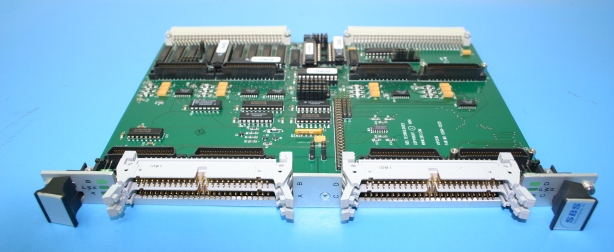

VIPC616 IP CARRIER BOARD
The VIPC616 VMEbus IP carrier is part of the IndustryPack® family of modular I/O components. As a carrier board, the VIPC616 provides mechanical support and the electrical interfaces to four single high IndustryPacks, or two double high IPs.
Input/output, memory, and interrupt functions are supported.
VIPC616 meets VMEbus Specification C.1 (also known as IEEE P1014/D1.2 and IEC 821 bus) for 6U, or “double high,” form factor. Other VMEbus IP carrier boards are available with different capabilities, including 3U (single high) form factors, on board DMA, or other processors. Carrier boards are also available for other industry standard buses, including; PCI, ISA (IBM XT/AT) bus and Nubus (Apple Macintosh).
The VIPC616 conforms to the IndustryPack Logic Interface Specification. This guarantees compatibility with the wide range of IndustryPacks currently available and planned.
Each of the IndustryPacks interfaces with a 50-pin flat cable header accessible on the front panel of the VIPC616. The four IP positions are generally called slots and are identified by the letters A, B, C, and D. The interfaces to all IndustryPacks mate to locking right angle receptacles. This arrangement provides inherent strain relief. The interface connectors are mounted directly on the VME board (not on the IPs), providing a stable and reliable cabling system. Interface cables may be inserted or removed with the VIPC616 in the VME chassis. IPs may be snapped in or out without interfering with the I/O cabling.
In addition to the front panel cabling, the C and D packs are also routed to the VMEbus P2 backplane connector. This permits more flexible cabling options in many chassis.
IndustryPack I/O is mapped into the VMEbus A16/D16 space. Both user and supervisor accesses are supported, as are read-modify-write (“test and set”) operations. The size of I/O on each IP is fixed by the IP Specification at 64 16-bit words. In addition each IP has an identification PROM which occupies 64 words. Thus the four IPs occupy 1024 bytes out of the VMEbus’ 64 k byte “short I/O” space.
Interrupts are fully supported with a simple but powerful architecture. Each of the four IPs is able to generate up to two interrupt requests. These eight request lines are paired with the seven available VMEbus interrupt request levels by a simple jumper block. Alternatively to this, a user provided PLD may be installed to perform arbitrarily complex interrupt mappings.
Six layer PCB construction minimizes conducted and radiated EMI. Extensive use of CMOS logic reduces both heat and electrical noise, while increasing reliability. All shunt, socket and connector pins are gold plated, assuring long reliable life.